TRANSLATIONAL RESEARCH
Lithium Battery Recycling Technology (CirCoLi)
A New Paradigm in Battery Recycling
TRANSLATIONAL RESEARCH
A New Paradigm in Battery Recycling
40x faster, highly-selective black mass dissolution with > 90% leaching yield
Cuts CAPEX by ~30% and OPEX by ~20%, lowering cost per ton of black mass by ~20%
Small footprint enables BM segregation, enabling direct pCAM and Li2CO3 synthesis
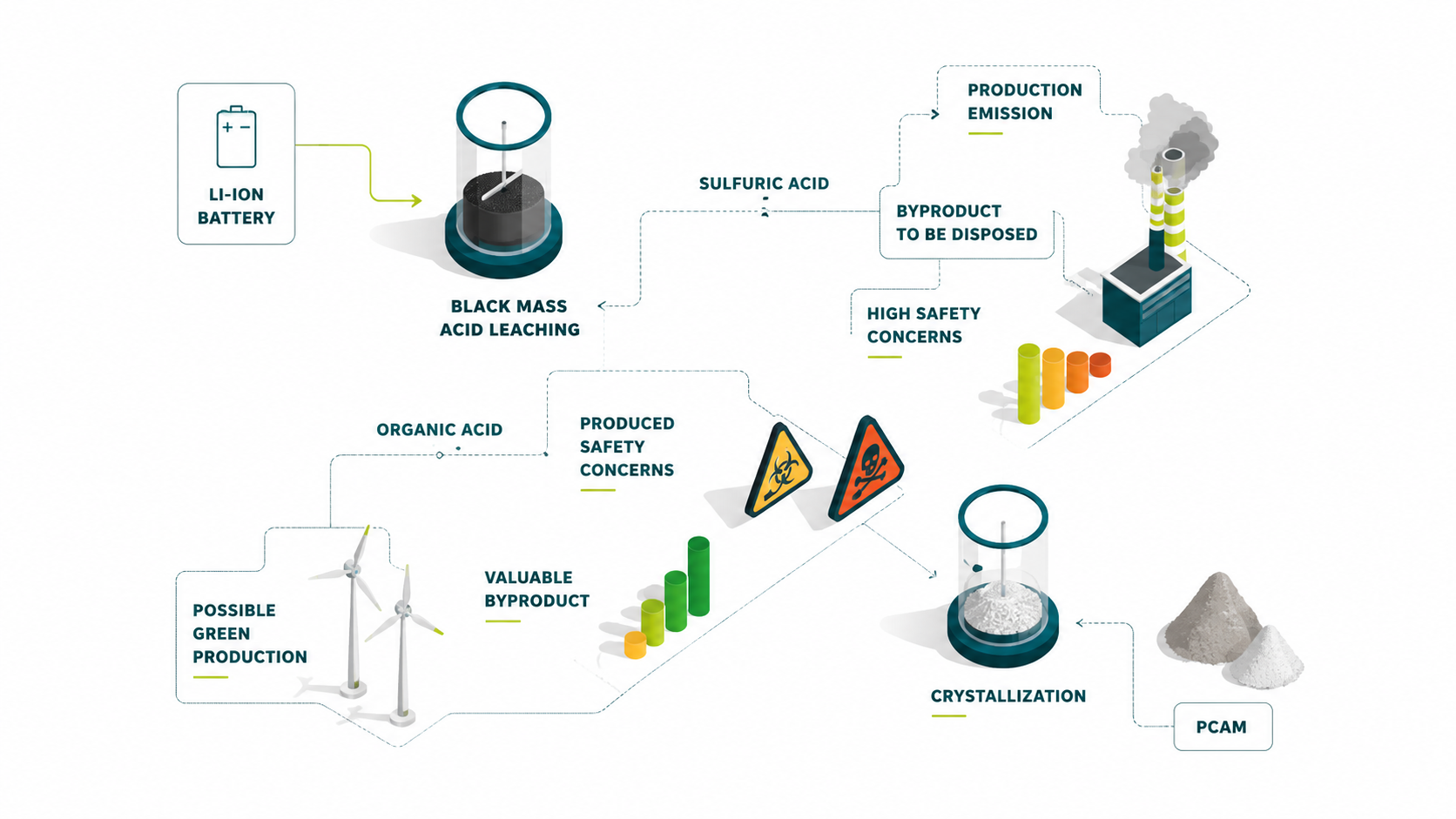
Team Roberts researchers are advancing a next-generation Li-ion battery recycling technology that integrates ultrasonic intensification with organic-acid leaching to enable fast, low-impact, and circular-compatible recovery of battery metals. The technology delivers an integrated product pathway that enables direct pCAM synthesis alongside battery-grade lithium carbonate (Li2CO3) production, reducing processing complexity while strengthening value capture from black mass.
The technology has been validated at pilot scale in a plant with capacity of up to 80 tons of cathode material per year. The project has secured approximately USD 2.5 million in support from RTG, NTI, and SIRC initiatives, and in 2025 was recognized with a Gold Medal at the International Exhibition of Inventions Geneva, Switzerland.
Our technology uses ultrasonically enhanced organic-acid leaching in a patented reactor. Organic-acid chemistry delivers high selectivity for valuable metals, while ultrasound accelerates mass transfer and kinetics to achieve leaching rates 20 to 40 times faster with more than 90% yield, enabling higher throughput and a smaller footprint. This compact process provides a direct pathway to pCAM synthesis and battery-grade Li₂CO₃ production, supported by a closed-loop design that recovers ethanol and recirculates water after neutralization. Techno-economic assessment indicates around 30% lower CAPEX, 20% lower OPEX, and about 20% lower cost per ton of cathode versus conventional technologies.