
24 February, 2026
The Cryogenic Carbon Capture (CCC) Project under Team Roberts is developing modular, containerized capture units that can be stacked on ships to capture CO₂ and SO₂ during multi‑week voyages, with purification completed onshore. This approach reduces system footprint and removes the need for heavy‑fuel scrubbers, generating excitement at events such as the Powering the Intelligent Age Summit 2025.
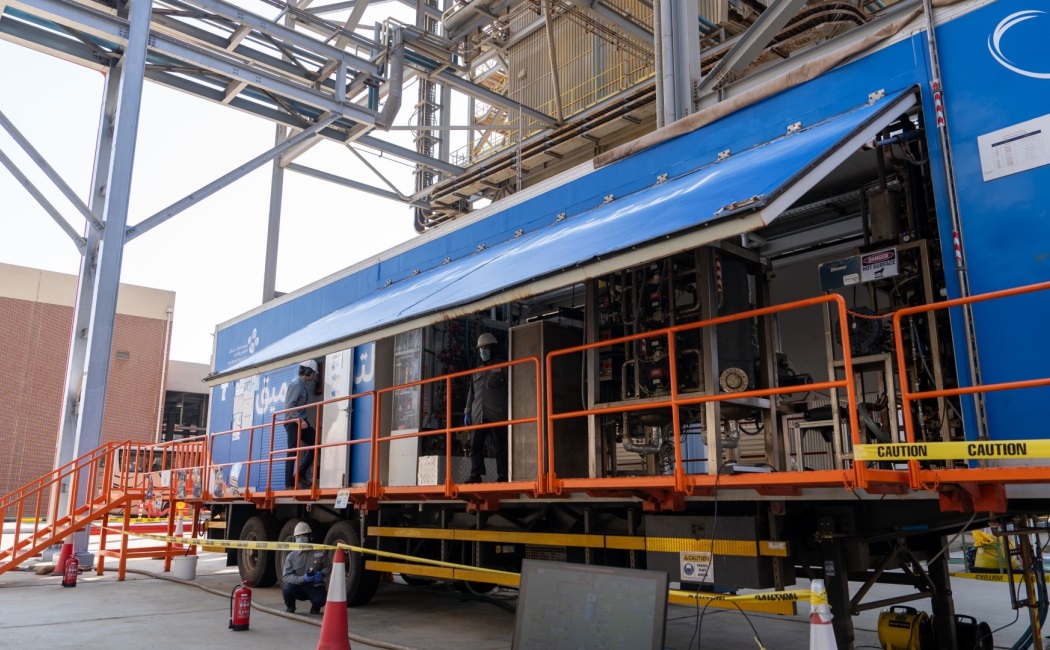
Since launching its pilot in 2020, the team has advanced CCC from a TRL 6 demonstration with Saudi Electricity Company (SEC) in Rabigh to a fully in‑house, IP‑driven technology platform. A new validation phase is planned, followed by a first‑of‑its‑kind 30‑ton-per‑day commercial unit for SEC.
Plans are also underway for a marine‑specific prototype, aligned with International Maritime Organization (IMO) decarbonization efforts. The system’s plug‑and‑play design captures pollutants in solid form with minimal onboard space — a key advantage in maritime operations.
The University’s mission-driven approach is enabling new IP, startup pathways, and funding opportunities through the National Transformation Institute, supporting Saudi Vision 2030 and the circular carbon economy.
The unique trailer-scale system has already captured more than 95% of CO₂ in continuous industrial operation. The process produces high‑purity liquid CO₂ suitable for petrochemicals, underground injection, and advanced power cycles, while effectively separating SO₂ and nitrogen oxides.
Building on operational experience and national partnerships, the team is steering CCC toward commercial readiness — contributing to meaningful emissions reductions on the path to the Kingdom’s 2060 net‑zero goals.
Original article published on KAUST News